The State of Used Car Buying in India (2026) With a Hyperlocal Deep Dive: Hyderabad By CarArth
Explore India's used car market in 2026 with a deep dive into Hyderabad. Discover CarArth's innovative Discovery Model transforming how you find the best used car deals.
India's used car market continues to evolve rapidly in 2026, driven by digital transformation, rising affordability demands, and the shift toward organized platforms like Cars24 and Spinny. While often labeled as "high-growth," the market's expansion is largely due to formalization rather than explosive new demand. This report explores the nuances, introduces the CarArth Discovery Model, and provides a focused lens on Hyderabad's hyperlocal dynamics.
Executive Summary
India’s used car market is frequently described as “high-growth.” However, structural analysis reveals a more nuanced reality:
The market is not expanding proportionally in volume as much as it is formalizing.
The rapid rise of organized platforms such as Cars24 and Spinny primarily reflects a migration of transactions from informal channels (unorganized dealers and classifieds like OLX) into structured, transparent environments.
Key persistent challenges include:
- Inefficient price discovery
- Fragmented inventory across dealers, individuals, and platforms
- Listing-driven user experiences that prioritize volume over relevance
This report introduces the CarArth Discovery Model — a forward-thinking framework that shifts the paradigm from passive, listing-based browsing to proactive, deal-oriented discovery.
By prioritizing clarity, aggregation, and assisted decision-making, CarArth addresses core pain points in India's evolving used car ecosystem.
Market Reality vs Perception
The Growth Narrative
Industry reports and signals frequently highlight:
- Increased digital penetration
- Platform-led transactions (e.g., Cars24, Spinny handling significant volumes)
- Strong reported YoY growth metrics
Recent data supports steady momentum: India's used car market was valued at approximately USD 36-40 billion in 2025 and is projected to grow from around USD 41.74 billion in 2026 toward USD 80-100+ billion by early 2030s, with CAGRs ranging from 11-15%.
The Structural Reality
A deeper analysis uncovers three core underlying dynamics: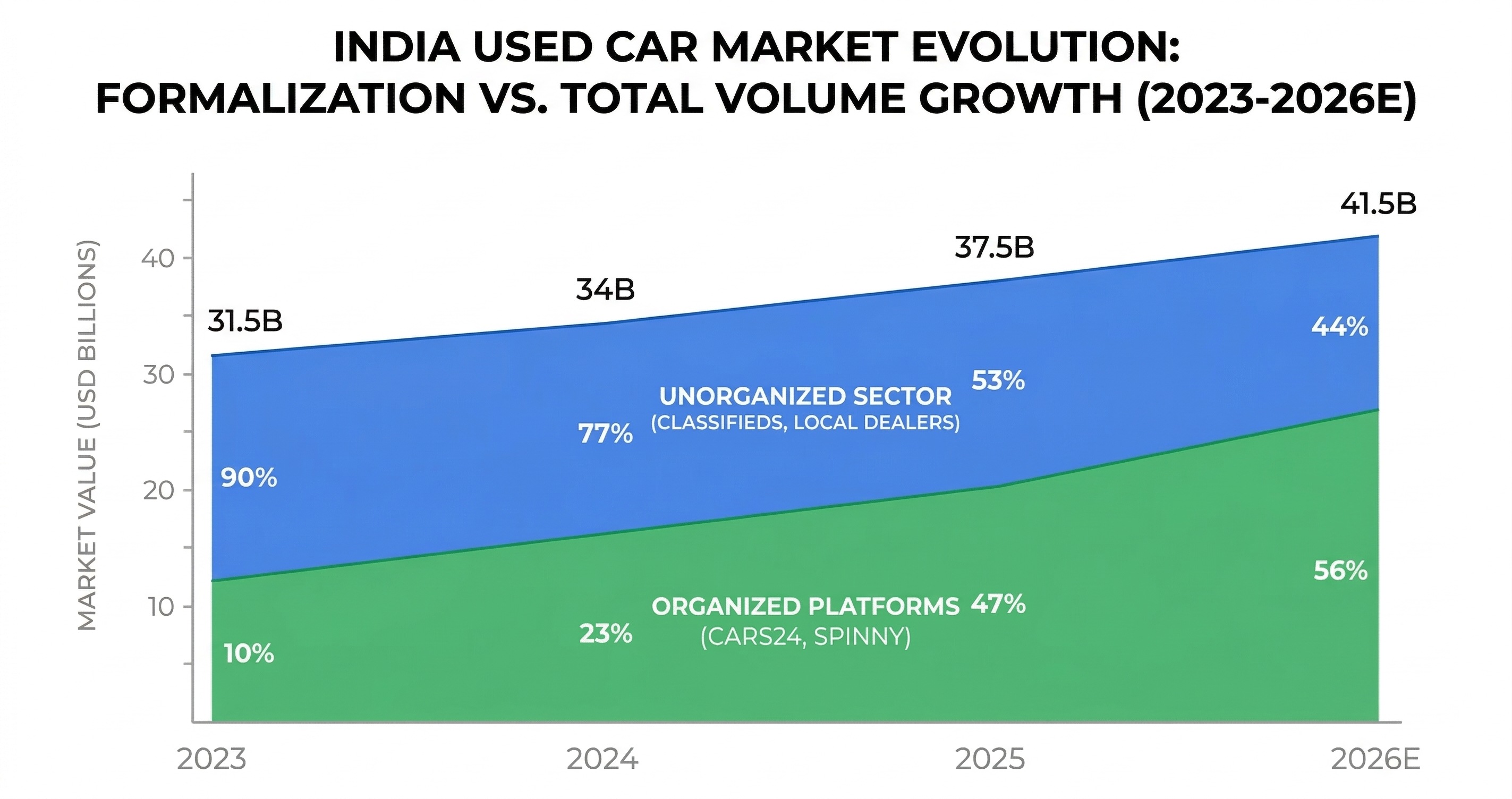
Channel Shift Dominates Growth
Much of the reported “growth” stems from migration away from unorganized dealers (still holding ~70% share in recent years) and reduced reliance on traditional classified platforms like OLX.
Organized players are capturing share through transparency, warranties, and financing — formalizing what was previously fragmented and opaque.Persistent Inventory Fragmentation
Used car supply remains highly distributed across local dealers, individual sellers, and multiple online/offline platforms — largely unaggregated at the user level.Information Asymmetry Remains High
Buyers still face:- Unclear pricing benchmarks
- Limited comparability across similar vehicles
Hyderabad: A Hyperlocal Market Lens
Hyderabad serves as a representative snapshot of urban used car dynamics in India.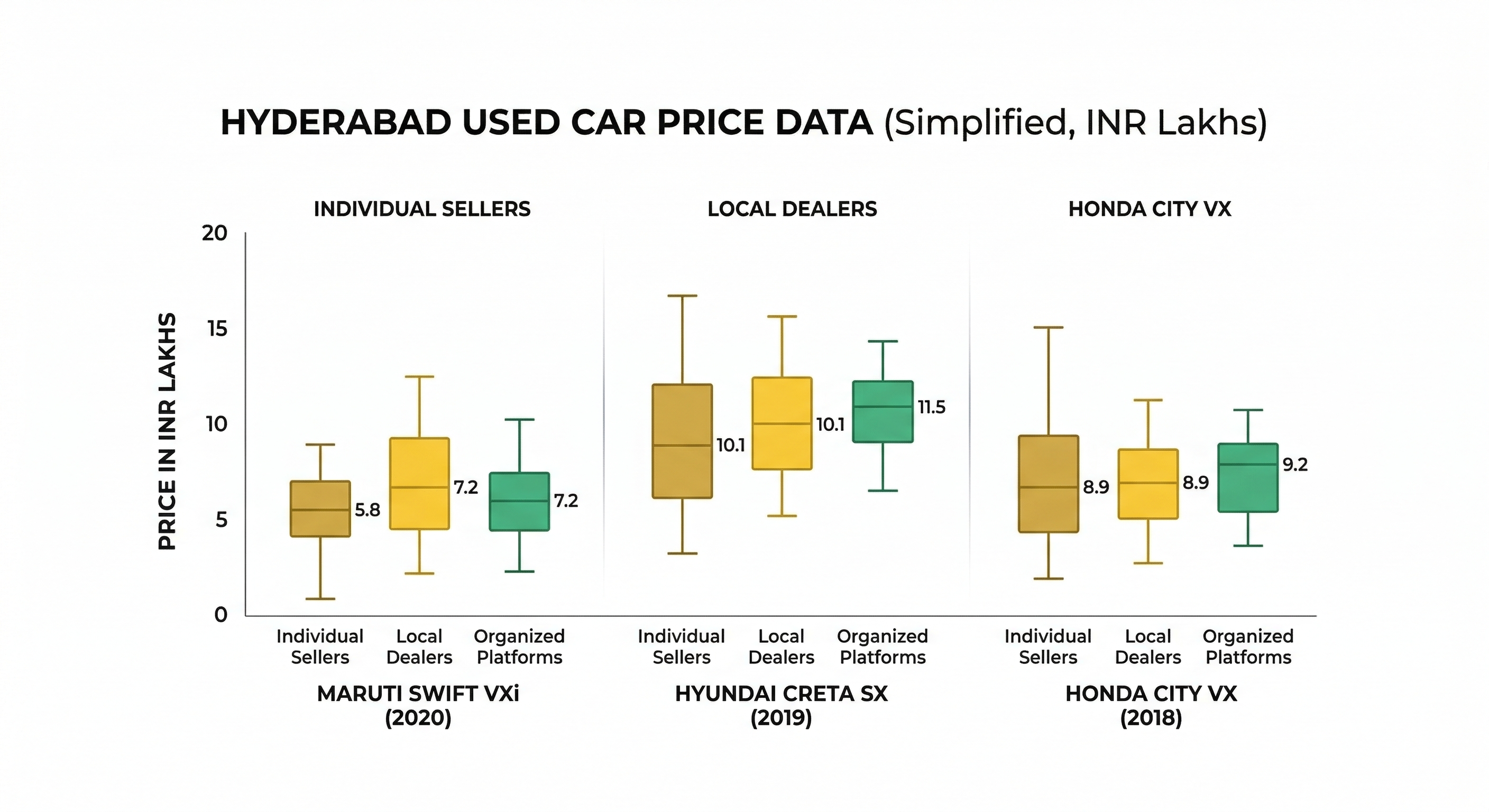
Market Characteristics
- Over ~20,000 active listings across major sources
- Significant duplication of vehicles across platforms
- Wide price variation for comparable vehicles
Key Observations
Price dispersion is structurally embedded — Identical or near-identical vehicles show significant price differences due to:
- Seller type (individual vs dealer)
- Platform visibility and promotions
- Urgency and negotiation flexibility
Dealer premiums persist — Dealer-listed vehicles often command higher pricing but offer perceived trust, convenience, and after-sales support.
No single source of truth exists — Buyers must navigate multiple platforms and manually reconcile information.
Limitations of the Listing-Based Model
Most current platforms rely on a listing-first architecture.
Monetisation-Driven Visibility
- Paid listings and promotions heavily influence what users see first
- Not all inventory surfaces equally
Browsing Over Discovery
Users typically:
- Scroll through large volumes of listings
- Apply basic filters with limited contextual intelligence
Weak Comparability
- Similar vehicles are not consistently grouped or ranked by true value
The Shift Toward Discovery
A fundamental transition is underway:
From: “Where can I browse cars?”
To: “Where can I find the best deal?”
This marks the rise of discovery-first platforms.
The CarArth Discovery Model
carArth introduces a framework centered on decision-making rather than browsing.
Core Principles
- No Paid Listings — Neutral visibility, no artificial ranking.
- Hyperlocal Aggregation — City-level focus for higher density and relevance.
- Deal-Centric Interface — Value and relevance prioritized.
- Agentic Assistance — Intelligent agents (Ms 7 and Master 7) filter noise and highlight opportunities.
Conceptual Shift
Aspect Traditional Model carArth Discovery Model Core Focus Listing-first Discovery-first Visibility Paid / Promoted Neutral / Merit-based Navigation Manual browsing Assisted / Guided Data View Platform silos Aggregated hyperlocal viewDefining Key Market Concepts
Price Truth Gap
The delta between visible (promoted) price and true market price, due to biases and lack of aggregation.
Discovery Efficiency
Speed and accuracy of finding the right vehicle → less browsing, better decisions.
Deal Signal
Structured indicator of listing attractiveness (price, condition, context).
What Changes Next
Agent-Led Interfaces Become Standard
Shift from passive to guided, AI-assisted decisions.
Hyperlocal Depth Outperforms National Breadth
Deep city data wins over shallow national coverage.
Decline of Listing-Centric UX
Scrolling replaced by ranked opportunities and insights.
Conclusion
The evolution of India’s used car market in 2026 is a transition from visibility to clarity, and from listings to true discovery.
The CarArth Discovery Model leads by removing biases, aggregating supply hyperlocally, and enabling efficient decisions. As formalization accelerates, discovery-first platforms will define the future.
Related Reading
- Explore all Throttle Talk guides and insights
- Best Used Car Platforms in India (2026): Platform Types, Fee Models, Inspection Claims & Buyer Stack
- CARS24 vs Spinny: Better for Buying or Selling? (2026)
- OdoShield vs Cars24 Odometer Tampering Check: Which Tool Better Protects Used Car Buyers in India? (2026)
- Learn how CarArth OdoShield checks odometer fraud
- Browse used cars in Hyderabad on CarArth